
Breathe Better with a Golden Pothos in Every Room
Why Golden Pothos Removes Indoor Chemicals — and Why It Matters
Golden pothos removes indoor chemicals like formaldehyde, benzene, toluene, and xylene — making it one of the most effective and affordable natural air purifiers you can keep at home.
Here’s a quick look at what it tackles:
| Chemical | Common Source | Pothos Removes It? |
|---|---|---|
| Formaldehyde | Furniture, flooring, cabinets | Yes — most effectively |
| Benzene | Paints, detergents, plastics | Yes |
| Toluene | Adhesives, nail polish, paint | Yes |
| Xylene | Varnishes, cleaning products | Yes |
| Acetone | Nail polish remover, solvents | Yes |
| Ammonia | Cleaning sprays, fertilizers | Yes |
Most of us spend the vast majority of our time indoors. And indoor air is often 5 to 7 times more polluted than outdoor air, according to research on indoor air quality.
That’s a real problem — especially if you deal with allergies, asthma, or breathing issues at home.
The good news? A humble trailing plant sitting on your bookshelf may actually help.
NASA researchers identified golden pothos (Epipremnum aureum) as one of the best houseplants for removing indoor air pollutants. It works through its leaves, roots, and the microbes living in its soil — absorbing harmful gases and breaking them down.
And it’s one of the easiest plants alive to keep healthy.
In this guide, you’ll learn exactly how pothos cleans your air, how to get the most out of it, and how many plants you actually need to make a difference.
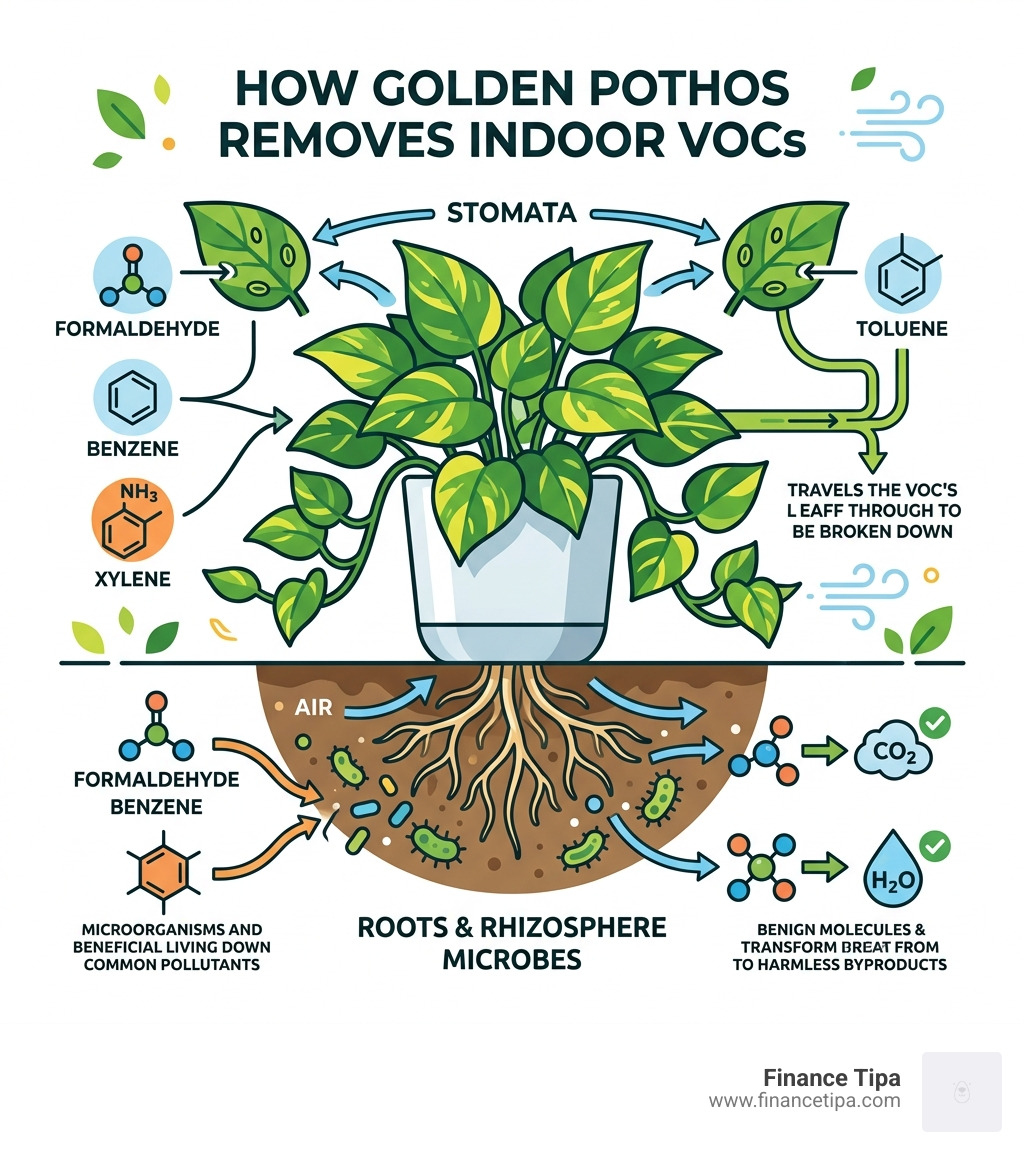
The Science of How Golden Pothos Removes Indoor Chemicals
To understand why we recommend this plant so highly at Finance Tipa, we have to look at the hard data. The ability of Epipremnum aureum to clean our air isn’t just a “green thumb” myth; it is backed by decades of laboratory testing.
According to the Purification Effects of Golden Pothos and Peace Lily for Indoor Air-Pollutants and its Application to a Real Environment – ADS, the Golden Pothos is a powerhouse when it comes to volatile organic compounds (VOCs). In controlled chamber studies, researchers found that the plant follows “first-order system dynamics.” In plain English, that means the plant starts cleaning immediately and works consistently to lower pollutant levels.
The plant targets a “rogue’s gallery” of indoor toxins:
- Formaldehyde: Found in pressed-wood products and carpets.
- Benzene: Often found in plastics, synthetic fibers, and detergents.
- Toluene and Xylene: Common in paints, finishes, and adhesives.
- Acetone: Frequently emitted by household solvents and nail polish removers.
A fascinating technical note on chemical removal characteristics reveals that the plant’s efficiency is closely tied to the molecular weight of the chemical. Generally, the smaller the molecular weight, the faster the Pothos can process it. This is why it is particularly legendary at removing formaldehyde.
The process happens through three main channels:
- Stomata Absorption: Tiny pores on the leaves (stomata) breathe in these gases during normal respiration and photosynthesis.
- Root-Microbe Degradation: Toxins are pulled down to the root zone, where specialized soil bacteria break them down into food for the plant.
- Waxy Cuticle: The leaves themselves can absorb certain fat-soluble chemicals directly through their surface.
Why Golden Pothos Removes Indoor Chemicals Better Than Other Plants
You might wonder why we don’t just fill our homes with any random green plant. While many plants help, the Golden Pothos has a few “superpowers” that set it apart.
First, there is the NASA endorsement. In their landmark Clean Air Study, NASA rated Golden Pothos as one of the top performers for removing formaldehyde and benzene. Its secret lies in its massive surface area. Because Pothos grows in long, trailing vines with numerous heart-shaped leaves, it offers more “scrubbing surface” per square inch of floor space than a vertical, slow-growing plant.
Furthermore, its waxy leaves are excellent at physical purification. They act like a static magnet for household dust, trapping particulate matter that would otherwise end up in our lungs.
For those looking for the future of air care, scientists are even working on research on enhanced removal via genetic modification. Researchers have successfully modified Pothos Ivy to express a mammalian gene (cytochrome P450 2e1), which allows the plant to destroy chemicals like chloroform and benzene at even higher rates. While your standard nursery Pothos isn’t “GM” yet, its natural ability is already world-class.
How Golden Pothos Removes Indoor Chemicals in Low Light
One of the biggest hurdles to indoor gardening is light. Many high-performance plants quit working if they aren’t in a sun-drenched window. The Golden Pothos is different. It is nicknamed “Devil’s Ivy” because it is nearly impossible to kill, even in dark corners.
Even in low-light conditions (around 500 to 1000 lx), the Pothos continues its metabolic processes. While its golden pothos removes indoor chemicals most efficiently when it has enough light to fuel rapid photosynthesis, it remains active even in office settings with only fluorescent bulbs.
As it breathes, it performs a beautiful trade with us: it takes in the carbon dioxide we exhale and the toxins our furniture off-gasses, and it releases fresh, filtered oxygen. Research shows that while light intensity positively correlates with removal rates, the Pothos is one of the few plants that maintains a steady “purification rate” even when the lights go out, thanks to the microbes in its root system that work 24/7.
Optimizing Your Pothos for Maximum Air Purification
If you want your Pothos to work like a high-end HEPA filter, you can’t just “set it and forget it.” Certain conditions will supercharge its ability to scrub the air.
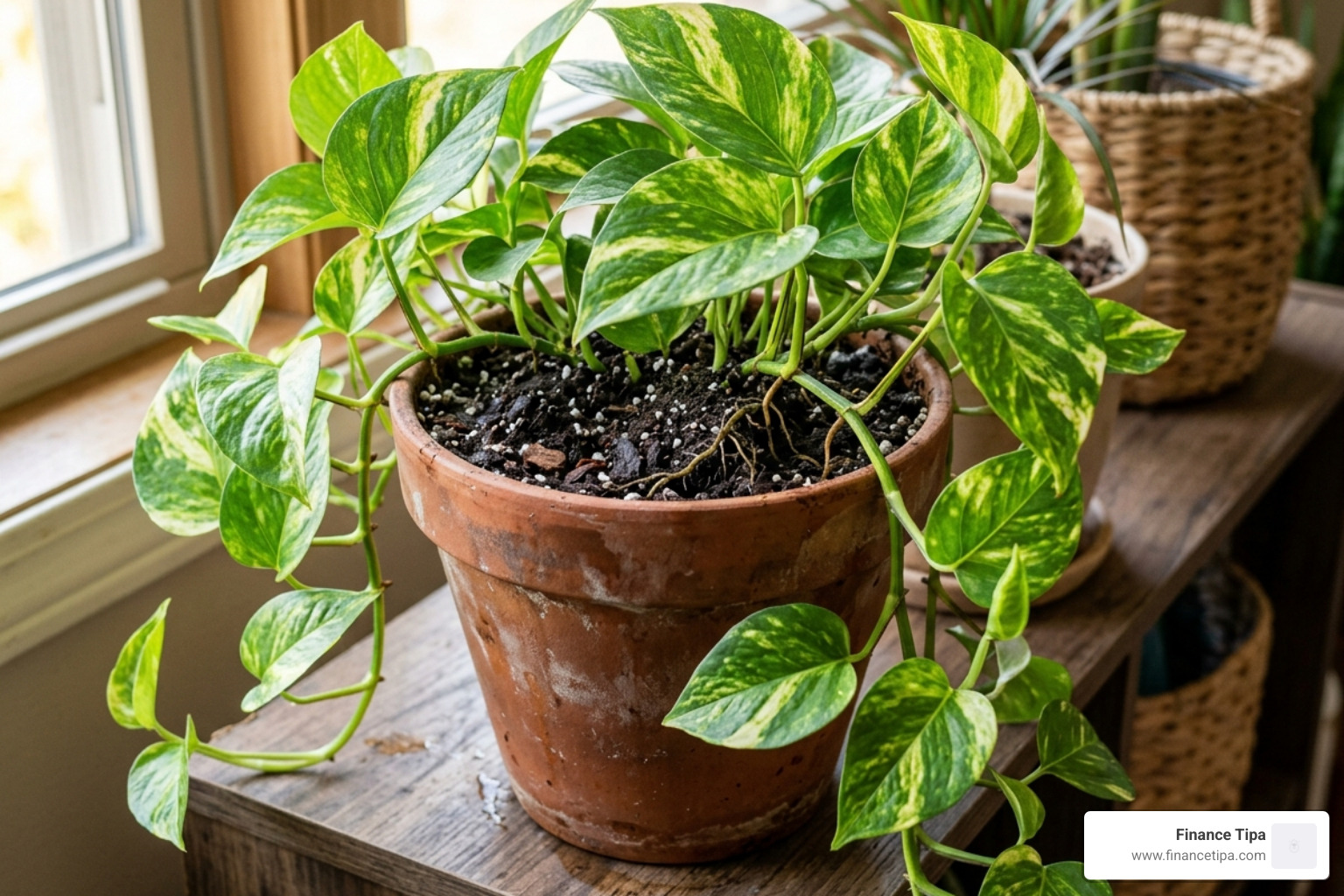
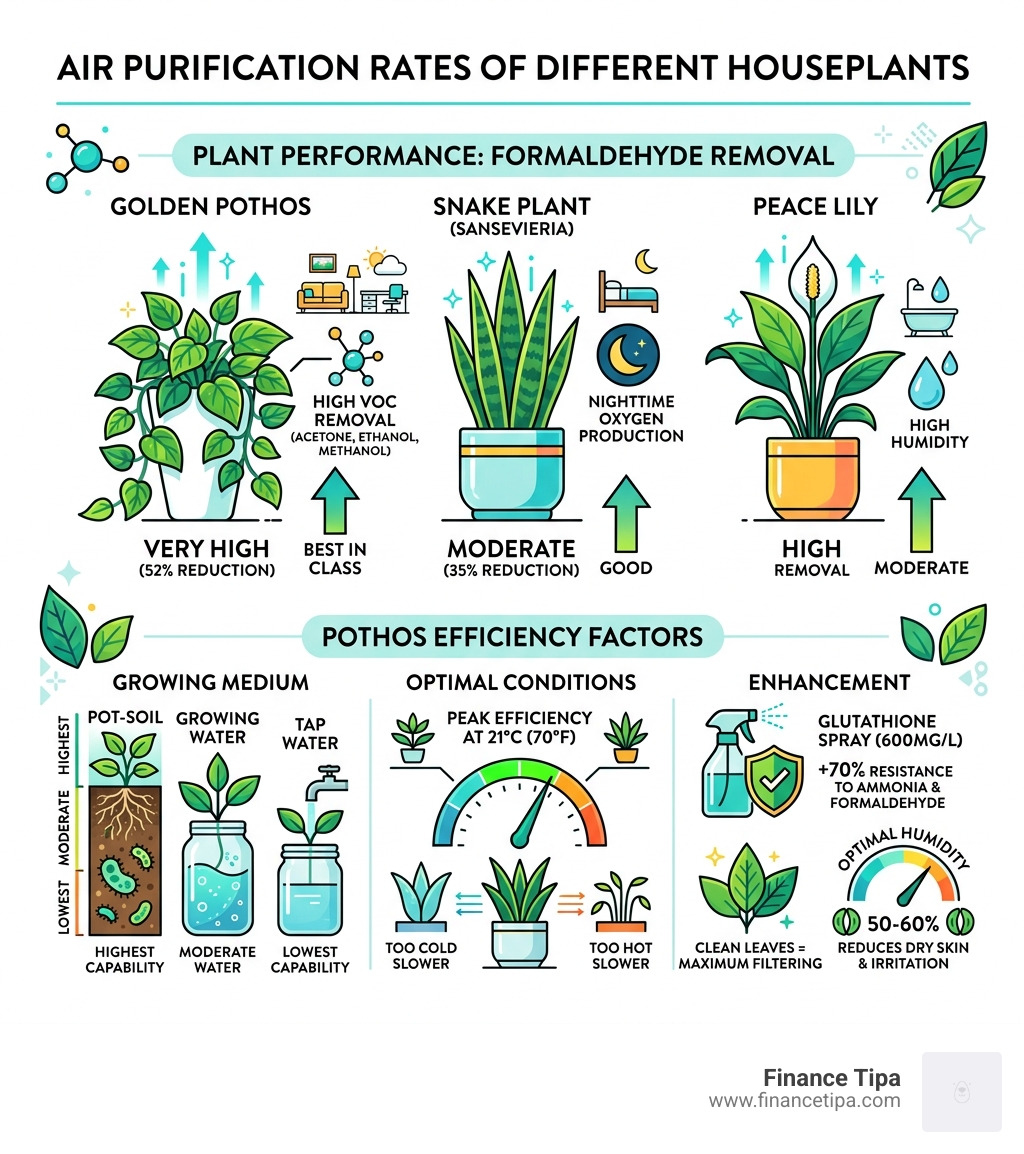
The medium you grow it in matters immensely. A Technical note Purification characteristics of pothos for airborne chemicals in growing conditions and its evaluation found that Pothos grown in traditional pot-soil outperformed those in hydroculture (water only).
The order of effectiveness for formaldehyde removal was:
- Pot-Soil: Highest capability (due to the combined power of roots and soil microbes).
- Growing Water: Moderate capability.
- Tap Water: Lowest capability.
Temperature also plays a critical role. Studies have shown that the Pothos’ ability to purify 8ppm of formaldehyde (which is 100 times the standard guideline) peaks at exactly 21°C (70°F). When the room gets too cold or too hot, the plant’s metabolism slows down, and its air-scrubbing efficiency drops.
We also found some cutting-edge research on antioxidant sprays for plant resistance. Scientists discovered that spraying Pothos leaves with glutathione (600mg/L) can increase the plant’s resistance to high levels of ammonia and formaldehyde by up to 70%. This prevents leaf injury and keeps the “filter” running even in highly polluted environments.
Enhancing Performance with Soil and Water Quality
To keep the microbial activity in the soil at its peak, we recommend using a high-quality, well-draining potting mix. These microbes are the unsung heroes of air purification; they take the chemicals the leaves absorb and turn them into harmless organic compounds.
When it comes to water, consistency is key. While Pothos is drought-tolerant, a plant under stress won’t purify the air as well as a thriving one. Interestingly, the use of “growing water” (water with added nutrients) helps maintain a constant purification rate compared to plain tap water.
If you really want to go the extra mile, maintaining a humidity level of around 50-60% helps the stomata stay open and active. This doesn’t just help the plant; it helps you, too! Plants like the Pothos and Spider plant can actually increase room humidity, which reduces dry skin and respiratory irritation during the winter months.
Comparing Pothos to Other Air-Purifying Plants
How does our favorite vine stack up against the competition? We’ve looked at the data from the Comparative study on Pothos and Sansevieria and other NASA-based research to bring you this comparison:
| Feature | Golden Pothos | Snake Plant (Sansevieria) | Peace Lily |
|---|---|---|---|
| Overall VOC Removal | Very High (52% reduction) | Moderate (35% reduction) | High |
| Formaldehyde Removal | Best in Class | Good | Moderate |
| Best For… | Living rooms & Offices | Bedrooms (Nighttime O2) | High-humidity areas |
| Light Needs | Low to Bright Indirect | Very Low to Bright | Medium Indirect |
| Maintenance | Easy (Hard to kill) | Easiest (Indestructible) | Moderate (Diva-ish) |
The Golden Pothos is significantly more effective at absorbing acetone, ethanol, and methanol than the Snake Plant—sometimes by as much as six times! However, the Snake Plant has a unique “CAM” metabolism that allows it to produce oxygen at night, making it the perfect partner for a Pothos in the bedroom.
Care Guide: Keeping Your Natural Air Filter Healthy
To ensure your golden pothos removes indoor chemicals at its maximum potential, you need to keep the “filter” clean. A dusty leaf is a clogged leaf.

Follow these simple steps for a high-performing plant:
- Light: Aim for bright, indirect sunlight. If the leaves lose their variegation (the yellow splotches) and turn solid green, they are craving more light. More light equals more energy for air scrubbing!
- Watering: Water every 7-10 days. Wait until the top inch of soil is dry. Overwatering can lead to root rot, which kills the beneficial soil microbes we need.
- Leaf Cleaning: This is the most forgotten step. Every month, wipe the leaves with a damp cloth. This removes dust and allows the stomata to “breathe” in those VOCs efficiently.
- Propagation: Don’t buy 20 plants—buy two and propagate! Pothos is incredibly easy to grow from cuttings. Just snip a vine below a node (the little brown bump) and stick it in water. In a few weeks, you’ll have a new “filter” ready for another room.
- Fertilizer: Use a balanced liquid fertilizer once a month during spring and summer to keep the foliage lush. More leaves = more purification.
Safety and Limitations of Pothos in the Home
While we love the Pothos at Finance Tipa, we believe in being fully transparent about its limitations and safety concerns.
Toxicity Concerns
The Golden Pothos contains calcium oxalate crystals. If chewed or swallowed, these can cause intense mouth irritation, swelling, and digestive upset.
- Pets: It is toxic to cats and dogs.
- Children: Keep plants on high shelves or in hanging baskets out of reach of toddlers.
Real-World Limitations
We have to be realistic: one tiny Pothos in a 500-square-foot room isn’t going to replace a mechanical HEPA filter for heavy smoke or industrial pollution.
- Plant Density: To significantly impact indoor air quality in a standard room, you generally need about one medium-sized plant (in an 8-inch pot) for every 100 square feet of space.
- Ventilation: Plants work best as part of a “holistic” system. You should still open your windows for 10 minutes a day to flush out CO2 and bring in fresh air.
- Particulates: While Pothos is great for gases (VOCs), it isn’t as effective at removing fine smoke particles or heavy pollen as a dedicated air purifier. We recommend using both for the best results!
Frequently Asked Questions about Golden Pothos
How many pothos plants do I need per room for clean air?
For a noticeable reduction in chemicals like formaldehyde, we recommend the “NASA Rule”: at least one plant per 100 square feet. For a standard bedroom, two trailing Pothos in hanging baskets usually do the trick!
Can golden pothos remove cigarette smoke and odors?
Pothos is excellent at removing the chemical components of smoke (like benzene and formaldehyde) and has been shown in studies to reduce general odors by up to 68% in real-world environments. However, it won’t remove the physical “soot” or ash from the air—you’ll still need a vacuum and a HEPA filter for that.
Conclusion
At Finance Tipa, we believe that enhancing your indoor living through better breathing is one of the best investments you can make for your health. The evidence is clear: golden pothos removes indoor chemicals effectively, sustainably, and beautifully.
By strategically placing these plants in your home, maintaining their soil health, and keeping those waxy leaves clean, you can create a natural bio-filter that works around the clock. It’s a simple, low-cost solution for a healthier, more vibrant home.
Ready to start your indoor garden? Improve your indoor air quality today and breathe easy knowing nature is on your side.
